
Learning About Drone UAV Components
Learning About Drone UAV Components
This Article will help you all about Drones | Source : Wikipedia
Click here to View Best Drones Range | Click Here to Buy Best Selling HD Camera Drones
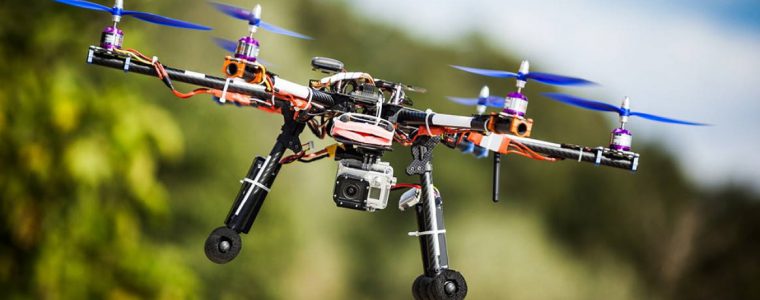
Manned and large unmanned aircraft of the same type generally have recognizably similar physical components, the main exceptions being the cockpit and environmental control system or life support systems. Some UAVs carry payloads (such as a camera) which weigh considerably less than an adult human, and as a result can be considerably smaller. Though they carry heavy payloads, weaponized military drones are also lighter than their manned counterparts with comparable armaments. Small civilian UAVs have no life-critical systems, and can thus be built out of lighter but less sturdy materials and shapes, and can use less robustly tested electronic control systems. For small UAVs, the quadcopter design has become popular, though this layout is rarely used for manned aircraft.
 Miniaturization also means that less-powerful propulsion technologies can be used which are not feasible for manned aircraft, such as small electric motors and batteries. Control systems for UAVs are often different than manned craft. For remote human control, a camera and video link are almost always a necessary replacement for the cockpit windows; instead of physical cockpit controls, commands are received by radio. Both manned and unmanned aircraft can have sophisticated autopilot software, though the features for autonomous drone operation are often different than those for large aircraft such as civilian passenger airliners.
Learning About Drone UAV Components
Body : Fuselage and wings for planes, tail rotor for helicopters, canopy, frame and arms for multirotors. Evolution toward 3D printing applies to UAVs to cut in the aircraft weight.
Power supply and platform : Small UAVs rely mostly at present on lithium-polymer batteries (Li-Po), while larger vehicles often use fuel or even solar power. Battery elimination circuitry (BEC) is used to centralize power distribution and often harbors a microcontroller unit (MCU). Costlier switching BECs diminish heating on the platform.
Computing : Early large UAVs could carry high computational capabilities due to their extended available payload and they did not urge engineers into miniaturization as they allowed complex-instruction-set chips. Processing power of civil-and-medium-domestic UAVs mostly leans toward reduced-instruction-set computer design. Common processor families there are AVR, PIC, ARM, with a current predominance of ARM’s 32-bit memory-address-register processors. Thus, small UAV embedded systems evolved from the blending terms of microcontrollers, to system-on-a-chip (SOC), and as far as single-board computers (SBC) at present.
UAV hardware is likely to specialize, with increasing numbers of operation per second and hardware acceleration as a background, between, on one hand, calculus speed in exchange for low processing power (time-critical applications), and high-computational-capacity, able to support full operating systems, trading with higher weight on the other hand. Small UAV control system hardware is often called, especially in hobbyists groups, the Flight Controller (FC), Flight Controller Board (FCB), or Autopilot.
Main sensors:
- Proprioceptive: IMU (gyroscope, accelerometer), compass, altimeter, GPS module, payload measurement…Exteroceptive: camera (CMOS, infrared), range sensors (radar, sonar, lidar)…
- Exproprioceptive: internal/external thermometer, gimballed camera…
- Degrees of freedom (DOF) refer to both the amount and quality of sensors on-board
- 6 DOF stands for 3-axis gyroscopes and accelerometers (a typical inertial measurement unit – IMU)
- 9 DOF refers to an IMU plus a compass
- 10 DOF adds a barometer
- 11 DOF usually combine a GPS receiver.
Actuators : Actuators found in UAVs depend heavily on the aircraft type: digital electronic speed controllers (which control the RPM of the motors) linked to motors/engines and propellers, servomotors (for planes and helicopters mostly), weapons, payload actuators, LEDs, speakers…
Software : The UAV computer software are layered in tiers with different time requirements. The combination of layers is sometimes called the flight stack, or autopilot. Onboard classical operating systems alone are not ideal for flying UAVs: high response times may be fatal to the aircraft. Thus they may be completed by externally supported middlewares: RaspberryPis, Beagleboards, etc. shielded with NavIO, PXFMini, etc. or designed from scratch for hard real-time requirements, like Nuttx, preemp-RT Linux, Xenomai, Orocos-Robot Operating System, DDS-ROS 2.0 for instance.